 Save to Pinterest
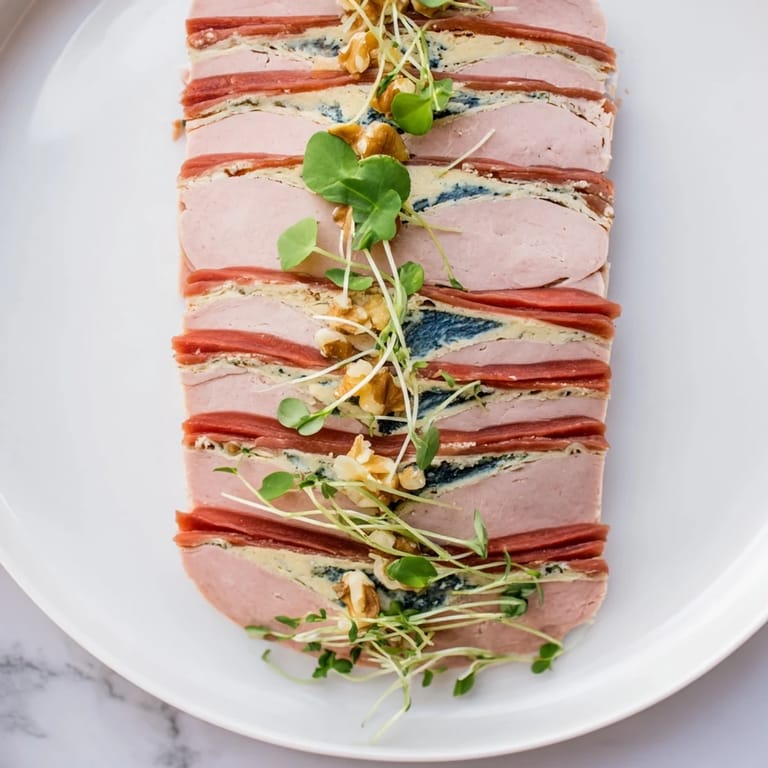
 I stumbled upon the Grand Canyon Rim terrine by accident, really—I was leafing through a travel magazine in a waiting room and saw this photograph of the actual canyon, those impossibly layered cliffs in rust and gold, and thought how extraordinary it would be to recreate that on a plate. The challenge grabbed me immediately: could meat and cheese and careful arrangement actually evoke that sense of geological time and wonder? Turns out, yes, though it took a few tries to get the layers stacking properly and the blue cheese river flowing just right through the center.
I made this for the first time when my sister visited from out of state, and I wanted to create something she'd remember beyond the usual roasted chicken. Watching her face when I unmolded it at the table and sliced through to reveal those perfect layers and that brilliant blue vein running through—that was worth every minute of careful arrangement and waiting for it to set.
Ingredients
- Beef sirloin, thinly sliced (300 g): The foundation layer that gives structure and richness; slicing it thin keeps it tender and allows it to conform to the pan shape.
- Turkey breast, thinly sliced (250 g): A leaner meat that contrasts with the beef and adds textural variety; it stays moist because of the custard binding.
- Smoked ham, thinly sliced (200 g): The smoky notes add complexity and depth that wouldn't be there with all fresh meats.
- Pork loin, thinly sliced (200 g): Mild and tender, it bridges flavors and prevents the terrine from feeling one-note.
- Blue cheese, crumbled (150 g): This is your river, your statement ingredient—choose a quality one because its character will shine, but not so aggressively funky that it overwhelms.
- Cream cheese, softened (100 g): It smooths out the blue cheese, making it spreadable while keeping it punchy.
- Heavy cream (30 ml): Just enough to make the mousse silky without diluting the blue cheese flavor.
- Fresh chives and parsley (1 tbsp each, finely chopped): These brighten the mousse and tie it to the earth-forward feel of the dish.
- Eggs (4 large): Along with milk and cream, these form the custard that binds everything together as it cooks.
- Whole milk (120 ml): Part of your binding custard that gently sets everything without becoming rubbery.
- Microgreens and edible flowers (optional garnish): These add a final visual pop when you plate it, making it feel restaurant-worthy.
Tired of Takeout? 🥡
Get 10 meals you can make faster than delivery arrives. Seriously.
One email. No spam. Unsubscribe anytime.
Instructions
- Set your stage:
- Preheat the oven to 160°C and line your loaf pan with plastic wrap, leaving plenty of overhang—this will be your safety net for unmolding without everything falling apart. Think of it as building scaffolding before you start the real work.
- Make your binding custard:
- Whisk together the eggs, milk, cream, salt, and pepper until completely smooth; this mixture will gently set as it bakes and hold all your layers together. Set it aside somewhere you'll remember it.
- Prepare your blue cheese river:
- Blend the blue cheese, cream cheese, heavy cream, chives, parsley, and black pepper until it's completely smooth and creamy. Taste it and adjust the pepper if needed—this is your moment to make it exactly right.
- Layer like you're building cliffs:
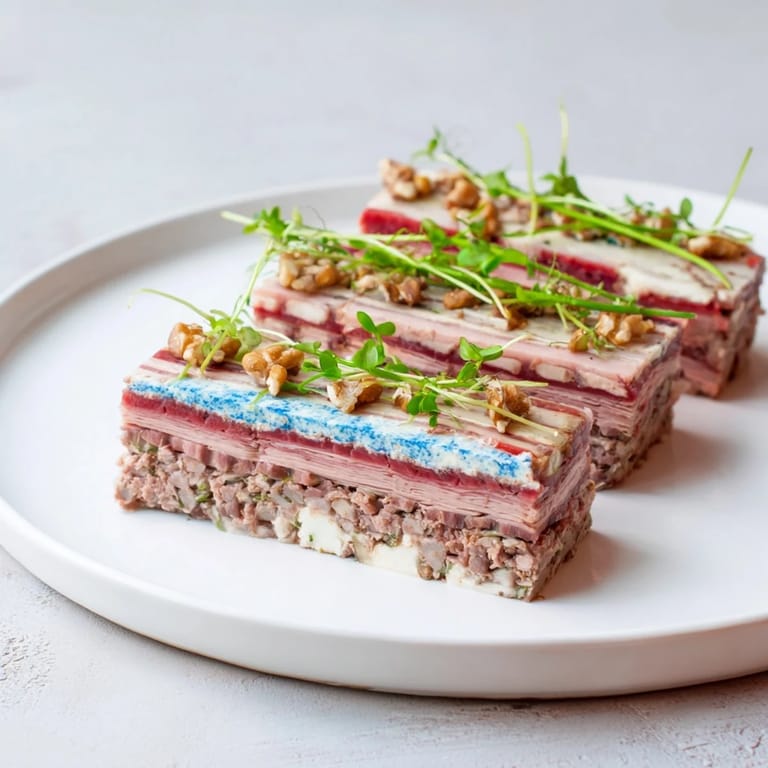
- Start with a layer of beef slices arranged so they slightly overlap, then turkey, then ham, then pork, each layer angling slightly as if the canyon walls are sloping. After every two or three layers, brush gently with the custard mixture to bind them together.
- Create your river:
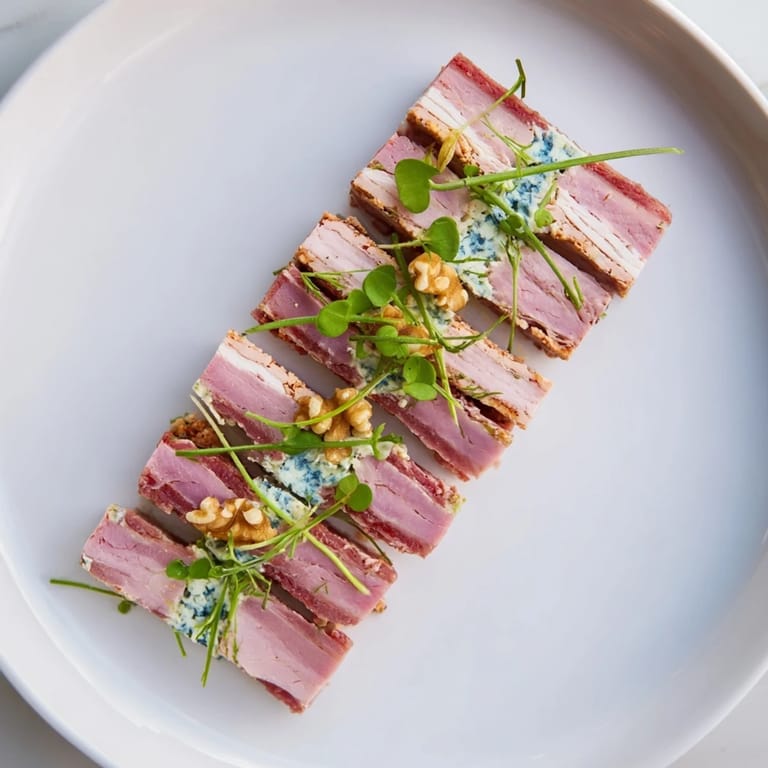
- When you're roughly halfway up the pan, spoon that blue cheese mousse down the center in a thick line, then continue layering meats around it and over it, maintaining that sloped, cliff-like effect. This is the reveal moment you're building toward.
- Seal and prepare for the bath:
- Fold the overhanging plastic wrap over the top to seal everything in, then wrap the whole pan tightly with foil. Place the loaf pan inside a larger roasting dish and fill that dish with hot water until it reaches halfway up the sides—this gentle, humid heat is crucial for keeping everything moist.
- Bake and chill:
- Bake for 1 hour 15 minutes until it's just set but still has a slight give in the center when you nudge the pan. Remove it, let it cool to room temperature, then refrigerate for at least 4 hours, ideally overnight, so everything settles and the flavors marry together.
- The grand reveal:
- Carefully unmold onto a serving platter by peeling back the plastic wrap and sliding the terrine out, then slice thickly with a sharp knife, using a gentle sawing motion. The cross-section is your masterpiece—those layers and that blue cheese river running through should be perfectly visible.
 Save to Pinterest
 There's something almost meditative about arranging those meat layers, knowing that all this careful work will be hidden until the moment you slice it open at the table. That first time my sister saw that blue cheese river revealed when I cut through, she actually stopped talking for a moment—and that's when I knew it was worth it.
Understanding the Terrine Structure
A terrine is fundamentally a composed dish where patience and precision create harmony; each layer matters, and the binding custard is what transforms separate ingredients into something cohesive. The water bath keeps everything from drying out or cooking too fast, essentially poaching the terrine in steam rather than dry heat, which is why the texture stays tender and luxurious. Think of it less as cooking and more as gentle engineering.
Variations and Substitutions
I've swapped the blue cheese for herbed goat cheese when I wanted something lighter, and it absolutely works if you prefer a milder tang. You can also experiment with smoked duck or prosciutto in place of some of the regular meats if you want deeper, smoky notes running through every layer. The core technique stays the same—it's really about choosing proteins you love and layering them with intention.
Serving and Pairing
This terrine deserves toasted brioche or crusty bread to accompany it, and a light salad with bright vinaigrette cuts through the richness beautifully. A light red wine like Pinot Noir or a crisp white like Sauvignon Blanc pairs wonderfully without overpowering the dish.
- Slice thickly and let each piece rest on the plate for a moment so the flavors settle before serving.
- Microgreens and edible flowers feel fancy but aren't necessary—sometimes the layers themselves are enough of a visual statement.
- This is a dish that improves with time, so don't hesitate to make it a day or two ahead; the flavors actually deepen as it sits.
 Save to Pinterest
 The Grand Canyon Rim terrine is proof that food can be as much about beauty and storytelling as it is about flavor. Every time I make it, I'm reminded that the time invested in layering and waiting is its own kind of cooking magic.
Recipe FAQs
- → What meats are used to create the layered effect?
Thin slices of beef sirloin, turkey breast, smoked ham, and pork loin are layered to mimic the canyon cliffs.
- → How is the blue cheese mousse prepared?
Blue cheese is blended with cream cheese, heavy cream, fresh chives, parsley, and black pepper until smooth to form a creamy mousse.
- → What binding ingredients hold the layers together?
A mixture of eggs, whole milk, heavy cream, salt, and pepper is brushed between layers to bind the terrine as it cooks.
- → Why is the terrine baked in a bain-marie?
Using a water bath ensures gentle, even cooking, preventing the terrine from drying out or cracking.
- → Can the blue cheese mousse be substituted?
Yes, it can be replaced with a herbed goat cheese mousse for a milder, less tangy flavor.
- → How long should the terrine chill before serving?
After baking, chill the terrine for at least 4 hours or preferably overnight to allow it to set firmly.